Tuesday, November 20, 2012

DAY 10 TUES. OCT. 9 PUNO AREA

A magical day in brilliant sunshine. We took bicycle taxis to the waterfront to catch a ferry in Puno harbour. The taxi bicyclists were athletic young guys who clearly enjoyed the downhill ride almost as much as we did. Naturally, we turned the trip into a race, with no clear winner.

The ferry transported us to a place that has lived in my imagination for years, since reading about it in National Geographic as a kid: the floating islands of Los Uros, an indiginous nation. We were greeted warmly and told how, for centuries, these people have lived on islands constructed out of the reeds which grow so plentifully on Lake Titicaca. The people have learned to adapt successfully to this life-style, using sustainable resources to survive. It was strange to walk on these islands, which have a slightly spongey and waterbed-like quality to them. The only nods to the modern world were solar panels and motorboats. We were introduced to a local woman named Margarita and her husband Jesus and were taken to their home where we posed for pictures before viewing the weavings and handicrafts she had made. Touristy? Yeah, probably, but we couldn't resist and bought a nice tapestry for a wall hanging. How authentic this all is is up to discussion. Certainly, to have so many artificial islands with cabins, a school, docks and boats just for tourists to view seems a bit much. We came away thinking that this was indeed a real place, but the locals have embraced the tourism possibilities quite well.

We then visited a school where a lovely young Uro woman, Amalia, held court. She made it out to university, but then came back to her home to help the local kids as a teacher. She's worked for free for three years, but now the Peruvian government has agreed to fund her school and pay her a salary. The kids were small and put on a nice display of singing and play for us. We entered the school and found it to be fairly well supplied and typically chaotic for a class of 5 year olds. We enjoyed the visit very much.

The bicycle taxi ride back to the hotel proved to be more of a task for our peddlers. Our poor guy fell behind the others and really had a hard time of it going uphill. Is there a message here for Lou and me? I'm hitting the pool and gym when I get home !!

In the afternoon, we visited a site on the far end of the lake where several pre-Inca and Inca tower tombs exist. A strenuous climb took us to the top of a cliff where a dozen or so tombs stood. Once again, mankind's need to make sense out of death came home to me. No matter the time period, no matter the location, no matter the people, we all need to try to make sense out of our common mortality and to somehow memorialize our departed. The fact that these tombs still stand after many centuries tells me that we, as a species, will always do this unless we learn to somehow conquer death itself. And that's not happening any time soon.


Our evening meal back in Puno featured a local delicacy: cuy, or deep fried guinea pig. We got to sample some as an appetizer: well, some of us, the braver and more adventurous ones, did. I jumped at the chance and found it flavourful and slightly boney. The taste? Most compare it to chicken. Me? I think I'd say it resembled groundhog. But one thing was for sure. As I looked down on the poor little critter, my earlier musings about mortality came back to me and I began to philosophize about ... ah hell, who am I kidding? He tasted good !!

DAY 11 WED. OCT. 10 PUNO - COPACABANA, BOLIVIA

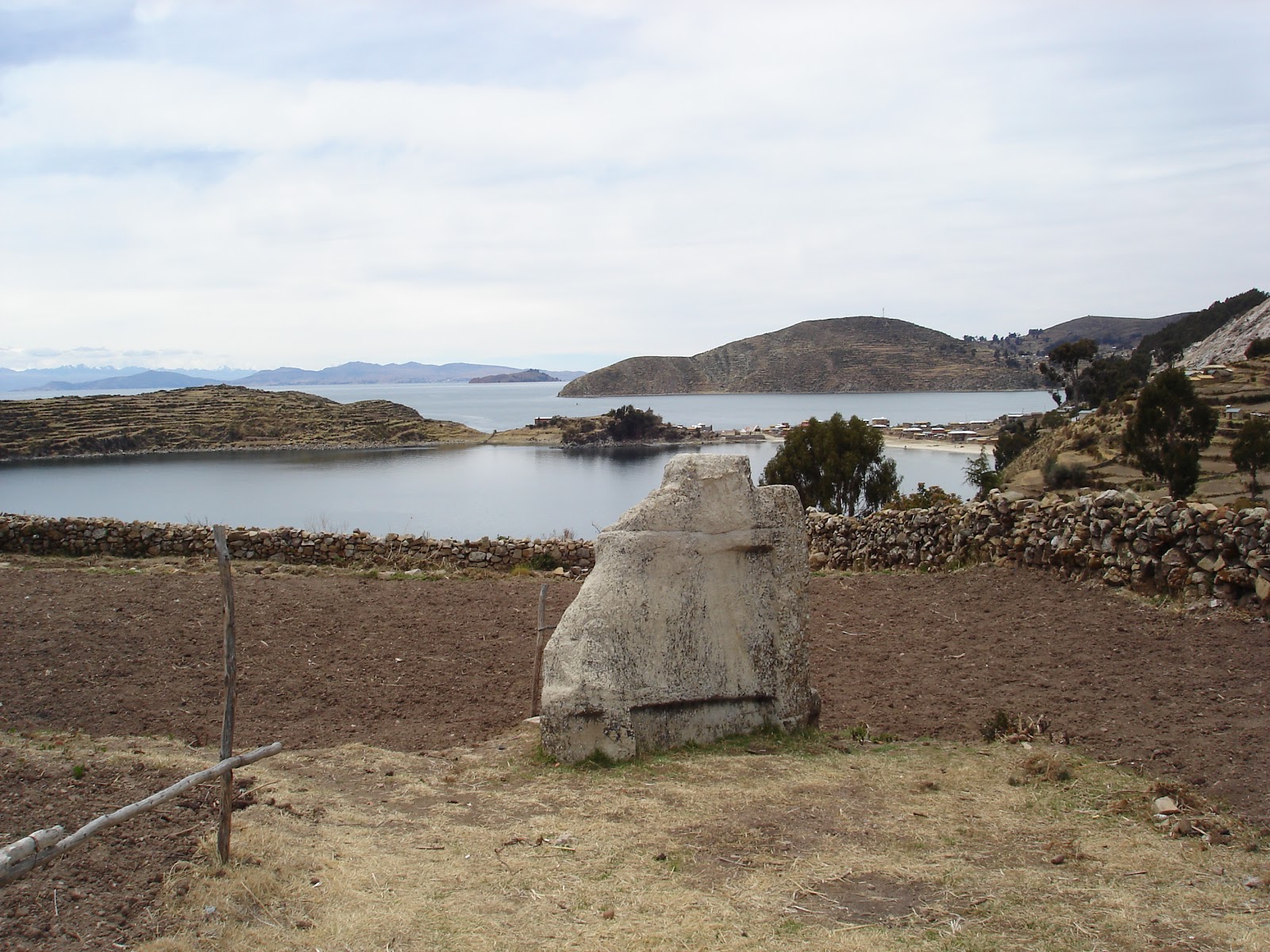
The brilliant sunshine continued as we drove from Puno around the huge and beautiful Lake Titicaca. We stopped at a fertility temple in a small town to marvel at the stone carvings of penises. Our group of travellers lost it when we saw these stone "mushrooms" and the jokes flew. Peter, one of the really good-humoured members of our group, offered the best pose of the day, which is captured for your enjoyment below: he's either a great jokester, or he's bragging !!

One of the little border towns on the Peruvian side featured a lovely 18th century stone church which was decked out inside with white streamers and flowers, looking for all the world like a wedding ceremony was about to take place. Instead, it was decorated this way to comemorate the upcoming planting season. Life affirming and wonderful, it was a way to celebrate existance, much like a wedding is.

We drove on around the lake until the border arrived. For the first time in my life, I walked across a border between two countries on foot. The crossing was smooth and efficient, thanks to our guides, Pablo and Tula: after all the formalities, we said goodbye to Tula and thanked her for her guidance and insights.

Boliva is impressive and backward: poor roads, little infrastructure, mostly indigenous and dirt poor. Until we came to our wonderful Hotel Rosario in the town of Copacabana: all rooms in this hotel over look the lake and are well decorated and well appointed. It is much like a hotel on the Greek islands, beautiful and luxurious. A long walk through narrow winding streets led by our local Aymara guide, Juan Carlos, took us to a stunning white and tile church the Aymara were forbidden to enter up to 1950! It was previously reserved for the white Spanish-speaking elite: the Aymara gathered in the outdoor patio around the church to worship. We shook our heads at this injustice, only corrected so recently. Juan Carlos was philosophical about it: he intimated that, yes, it was unjust that Aymara couldn't enter the church, but they enjoyed beautiful services in the brilliant open air and sunshine. Talk about being positive and optimistic, but, this is the way of aboriginal people all over the world when faced by such prejudice: make the best of the situation, but continue to fight with patience and dignity until the injustice is removed.


Change is coming to Bolivia, we were told. But it will be slow and sure in coming.

DAY 12 THURS. OCT. 11 COPACABANA - ISLA DEL SOL - COPACOBANA

This is the day of the hike to Puma Rock on Isla del Sol. We left our hotel a bit earlier in the day than most hikes and we were fewer in number: many stayed at the hotel for some R and R or because of illness. Lou stayed behind to catch up on some sleep and get some rest.

We had an hour and a half boat ride through some scenic and calm waters around many rocky islets. As we sailed, we were left mostly to our thoughts about what we were about to see. Our local guide, Juan Carlos had us all offer three drops of water from our water bottles to Pacha Mama for a safe journey and a good day's experience.

We arrived at a small village on Isla del Sol that is quiet and peaceful and a backpacker's heaven. The village was primitive in that it is untouched by the commercialism that often characterizes tourism. Several low buildings crowded a nice beach and featured a few hostels and bars. Campers set up some tents on the half-moon bay, the beach covered with fine powdered sand. Dogs and some pigs wandered with no fear and local women came and went, bent low to their daily tasks. I felt that I had arrived on some distant planet and became an unobtrusive observer of the slow pace of life on the island.

We climbed the trail at a steady and impressive pace. The clouds lifted and the sun came out glistening upon clear and calm lake water that sparkled more and more the higher we climbed. The tall, snow covered peaks of the Andes silently commanded out attention as they ranged perhaps 100 kilometers away. We passed the village school and were amazed as the kids began a long run up the trail ! We passed them later as they were returning, still keeping up a great pace and huffing as though they were jogging along a level track at sea level. Juan Carlos explained that the Aymara have many more red blood cells than we do to help with oxygen demand at high altitude. I silently wished for a transfusion of Aymara blood in my veins.
After a short distance, we encountered the local villagers preparing for a spring planting ceremony. The women were dressed in their red and white finery and the men were getting loaded on beer and other items. We said our polite good mornings and walked past, not wishing to intrude. Then Juan Carlos and Pablo called us back. Money exchanged hands, and the men favoured us with some great local music, rather basic but well played. The leader danced with a couple of our female hikers and we all clapped hands vigorously as the men played and drank. The local women gathered and seemed unimpressed. A couple of other locals, well lubricated, offered Juan Carlos a small taste of beer, which he accepted in order to maintain the air of friendliness. Pablo, not being Aymara, nor the rest of us, were offered any beer. We were told that, later that afternoon, a llama, also getting drunk, would be sacrificed to Pacha Mama in the hope of a good growing season. We did not see the llama.

We continued to climb. We passed many more locals working their small plots with hand tools as their ancestors had done. We encountered an elder and his wife who were guardians of a huaca stone on their land. The man didn't communicate much and Juan Carlos surmised that he was either ill or in a type of trance. We arrived at the sacred Puma Rock shortly after that and admired the panorama of Lake Titicaca and the far-off snow caps of the highest Andes. Juan Carlos told us it is customary to leave a stone at the foot of the Puma as an offering. I did so and thought of the llama waiting for its fate. We saw an Inca granary carved out of the cliff face ansd stopped for our lunch. Deb asked us if we'd ever imagined in our wildest dreams that we'd be sitting in an Inca sturcture eating lunch overlooking Lake Titicaca with the Andes in the background. We silently shook our heads no and contemplated the strange twists that life often gives us.

We hiked back, got in our boat for the long journey back to Copacabana. As we pulled away from the village, Pablo pointed out in the distance on the far shore of the bay all the villagers gathering for the ceremony wherein the llama would be sacrificed. It watched as long as I could, too far away to see any detail, but hoping the llama enjoyed his last day as much as I did.


We trudged back along the beach at Copacabana uphill to our hotel to reunite with our fellow travellers. The day ended with us gathered on a balcony overlooking our pleasant harbour, fishing boats contentedly bobbing in the gentle waters at anchor. With wine glasses in hand, we saluted an amazing sunset and thanked Pacha Mama for a wonderful day.

Monday, November 19, 2012

DAY 13 FRI. OCT. 12 COPACABANA - TIWANAKU - LA PAZ

We boarded our bus on a bright cool morning and reluctantly said goodbye to Copacabana. We are generally agreed that this sleepy little village will become a major tourist destination in the future. We drove through the now-familiar Altiplano, still dry and brown as it shakes off the last of winter and eagerly awaits the life-giving rain. Already, some fields are turning green as the first crop springs up.

An unexpected stop has us meet one of Bolivia's oldest and most respected celebrities. An elderly gentleman by the name of Paulino Esteban welcomed us to his home. Senior Paulino is famous for designing and building the read boats "Kon Tiki" and "Ra" used by the Norwegian explorer Thor Heyerdahl, who sought to prove the plausibility of ancient communication and travel between various Polynesian and Incan civilizations. Senior Paulino has been to Norway several times and is regarded as a master in his craft, as well as one of the last living connections to those expeditions. I had read about Heyerdahl's exploits in National Geographic, so this encounter was a treat, and Senior Paulino proved to be a delightful host.
Then, our crossing of Lake Titicaca in a rickety old water taxi had us wondering where the life jackets were. I couldn't help humming the theme from "Titanic" in my head, but we made it safe enough and continued to the mountains, rugged and gleaming in the distance. As we neared El Alto, a sister city to La Paz, we were jolted back to reality. El Alto is huge, unfinished, indigenous and absolutely chaotic. Few buildings were complete, most were brown brick and rebar. There were no sidewalks, only rubble where people walked, dogs barked and pigs rooted the soil. I wondered what this place would look like in the rainy season: nothing but mud, probably. The traffic was an absolute mess: no suggestion of lanes or order, just a constant slow, merging creep forward with horns blaring and pedestrians only shrugging at the last possible second before being hit by vehicles or animals or other pedestrians. I've never seen such insanity in an urban setting in my life: it was a mess !!

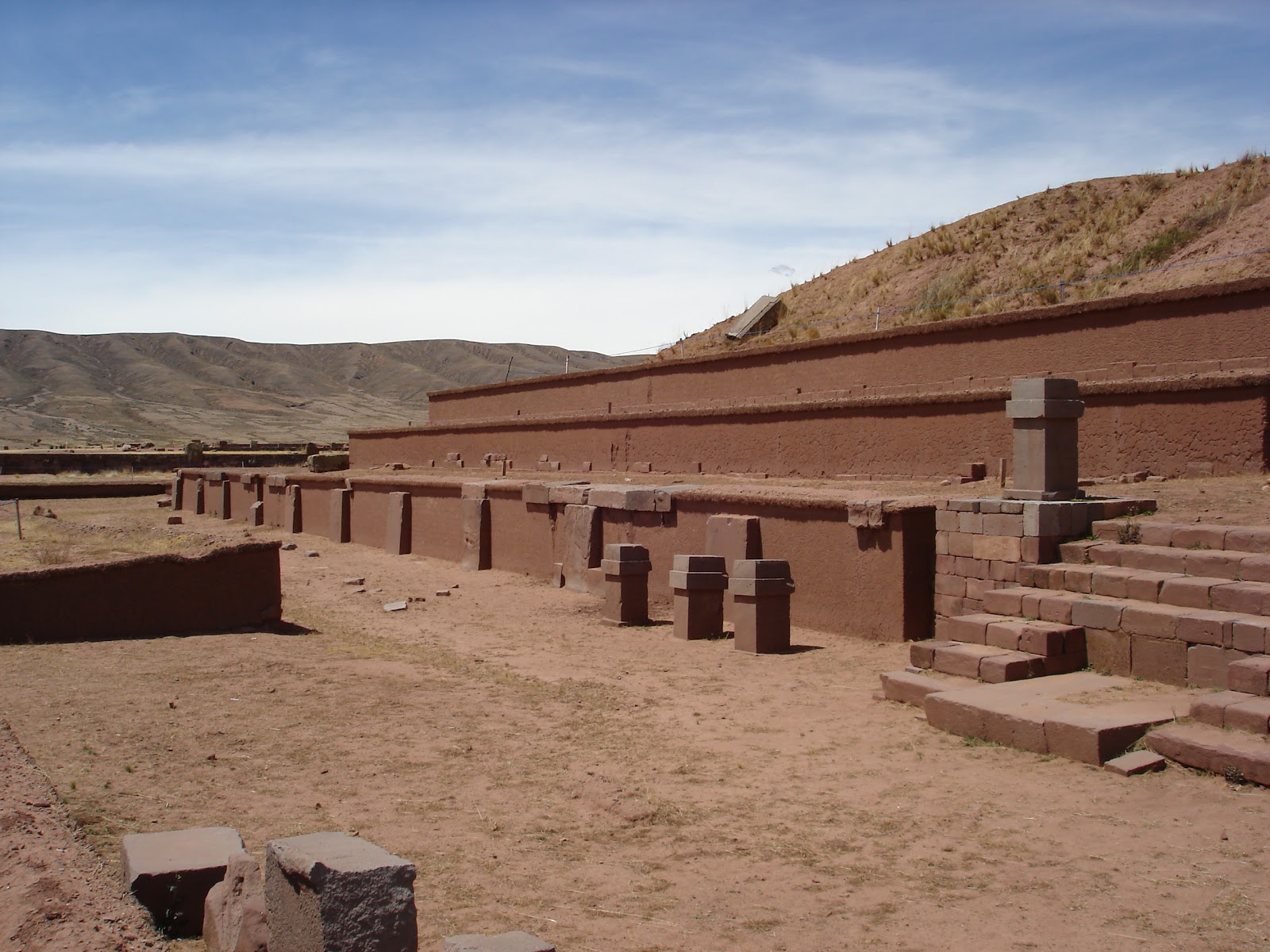
We picked up Gloria, our local guide near a market selling God-knows-what. She is a woman blessed with immense knowledge and a rapier wit. She entertained us with stories as we journeyed to the little known site of Tiwanaku. This was an old, pre-Inca culture which may have flourished around 1300 to 2000 years ago. They built large truncated pyramids and other temples and stellae that are only now being excavated. Then, they disappeared. Like the Maya of Central America, there are many theories as to their disappearance. But then came the Inca, whom Gloria compared to the Romans, and then, of course, came the Spanish. Gloria hoped that further excavation would reveal more of these ancient people, whom she considers to be her ancestors.

We backtracked through the post-apocalyptic chaos of El Alto into La Paz, which was a bit more finished, a tiny bit less chaotic and more Spanish. We passed a bizarre iron and steel statue of Che Guevara in one square. It's ironic how Che is a bit of a hero here, even though he was betrayed by the rural indigenous Bolivians he was trying to organize, and was killed here. But now, under the socialist president Evo Morales, Che's legend has been slightly rehabilitated.

As we neared our hotel, Gloria had us close our eyes on a highway cut-off. When we opened them, La Paz was laid out in all its glory below us. It was a tupendous sight, as we beheld a city of 2 million people cradled into a bowl created by the surrounding Andes.


Then we reached our hotel and I gave in to the virus that has been palguing many of our trip-mates. I'm sicker than a dog with a sinus head-cold as I write this. I missed the folklorico dinner-show that Lou said was really good. I'm staying in tonight and tomorrow, so La Paz will remain a mystery to me. Lou will have to soldier on without me.

DAY 14 SAT. OCT. 13 LA PAZ

Lou writes the following:

We boarded our bus, again with Gloria, and headed to the Moon Valley, which was gorgeous, very much in the way of Bryce Canyon, Utah. Gloria said that the rock is clay, not sandstone, however, and it was definitely more beige than the pinks of Bryce.

From there, we headed to a lookout "Qiri Qiri" for an amazing panoramic view, fighting traffic all the way. Apparently, our path took us past the military school where students were celebrating their graduation so throngs of proud parents and their cars filled the streets. On the way, we passed through some very high-end real estate. Gorgeoous 2 story houses surrounded by walls covered by cascading bouganvillea. There were also some in gated communities. These belong to year round residents, some of whom have German ancestry.

Next on to the gold museum. The pieces were lovely and stored in a series of rooms behind a vault door. Gloria noted sadly how few of them remained after being plundered by the Spanish, among others.

Our final stop on our morning city tour was the Witches' Market. Not a broomstick in sight as these are, in fact, women who sell amulets hoping to grant desires such as travel, children, etc. An aborted llama foetus placed under your living space is said to bring good luck!

Then we were left to our own devices to scour the many shops selling lovely textiles, t-shirts and many other handicrafts.


I'll finish off today's entry by thanking Lou for pinch-hitting. The day ended with a fine, but sad dinner at our hotel. I took just about every cold remedy in my travel bag and stiffled as many hacks and coughs as I could. It was the last night of our original group, and the last night of Peru and Bolivia. This has been a wonderful group of people to travel with and we say goodbye to all but 4 of them. Only Michael and Gail will travel with us to Ecuador. We wish the others "happy trails" as they head to other locations in Bolivia or back home to Canada or the U.S.

DAY 15 SUN. OCT. 14 LA PAZ - LIMA - QUITO

Today was fly day. My cold has improved to the point where I'm not snotting on everyone and everything. Thanks to our leader Pablo, we made all connections on time and seemlessly. We left La Paz early and I must admit I am eager to get away from the city I basically slept away. The 2 hour flight to Lima went smoothly. It was clear and our views were good. Lima itself was covered in cloud, but Lake Titicaca was visible in a sparkling blue immensity. We transferred to our second flight and arrived in Quito in the late afternoon. Quito has a busy and prosperous feel to it. We shall see it more completely later. Our hotel is beautiful and we met 4 new tavel companions in the light and refreshing rain for a pleasant dinner in the evening. Our newcomers are Ross and Barb from Vancouver and Bob and Marjorie from Missouri. The rainforest beckons tomorrow.

DAY 16 MON. OCT. 15 QUITO - COCA - SANI LODGE

Another early morning departure. Our flight from Quito to the jungle oil city of Coca lasted all of 25 minutes. It was amazing to see, in the clear sky, the brownish peaks of the Andes give way. Eventually, it was as though someone took a deep-pile dark green carpet and covered the hills. Then, the hills disappeared, and the broccoli-coloured immensity of the rainforest arrived.

We landed at Coca and the intense heat and humidity was a slap in the face. We've never experienced such heat and humidity and it was initially debilitating. We didn't want to do anything except find a shady corner to curl up and sleep.

Coca is a bustling city on the edge of the Ecuadorean oil industry. It is full of buildings that appear to be newly built, but in a hap-hazard way. Cars are everywhere, and bars and restaurants abound. It's a happening town. Apparently, this is the place to be when the oil workers are finished their stints in the hinterland. Pablo tells us that there's lots of oil in them thar' jungles, and there's now a serious decision looming for the people of Ecuador. If they go get the oil, there'll be jobs for lots of people, good paying jobs, and prosperity for the nation. But, the rainforest will be forever changed, and not for the better. There's also a booming tourism industry in the forest, and people, especially the local aboriginal people, benefit from these jobs, although they are being exposed to more and more influence from the modern western world. Tough decisions ahead.

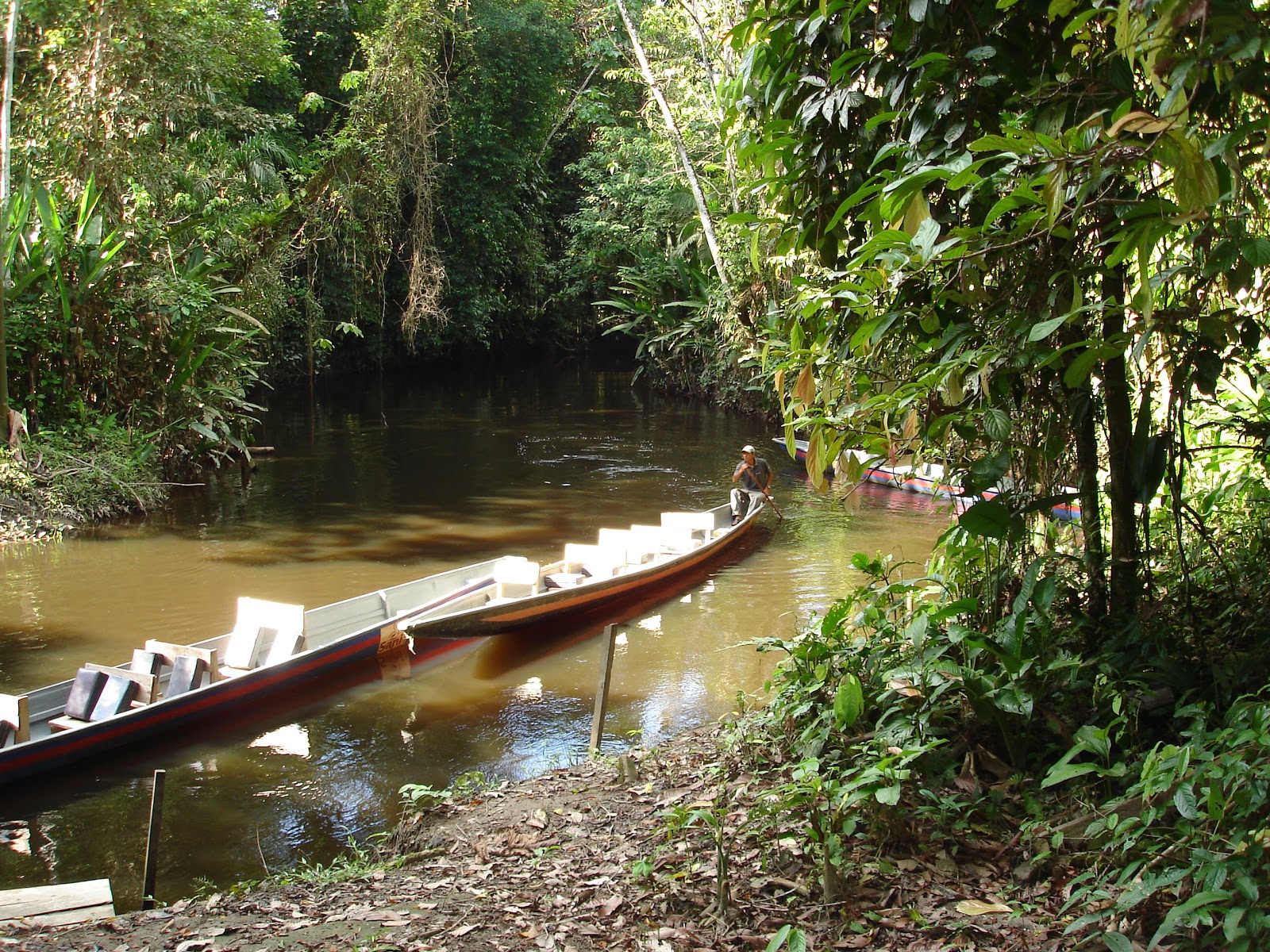
We boarded a motor canoe for a 3 hour ride on the Napo River, a huge tributary of the Amazon, and into the heart of darkness. It was an eerily wonderful trip, reminiscent of Apocalypse Now. The speed of the canoe created a nice breeze, so we temporarily forgot about our heat-induced misery. We passed other tour boats, oil barges, and many dugout canoes along the way, indicating that, despite the jungle appearance, the hand of human beings was very much a reality in this green, thick world.

Upon landing at a dock along the river, we hiked for about 20 sweat-soaked minutes along a boardwalk trail: many of the boards had rotted away with the humidity, so the walk was treacherous. Then, we boarded dugout canoes and went further in country. The vegetation was lush, green and dense. We arrived at our lodge, settled in and enjoyed some cold beer, a much appreciated and very temporary relief from the heat. A wonderful dinner awaited us. Despite being in the middle of a vast jungle environment, we were not removed from our creature comforts, although the Sani Lodge itself would never be labelled as luxurious. But that's the appeal of the place. It is run by the locals, and is good, basic, solid and clean. They specialize, however, in absolutely delicious meals, bordering on the gourmet. Nice decision, that: put all the emphasis on the true experience, make the accommodations plain, but go nuts on the food. That's the way I'd do it !

After enjoying our dinner, Pablo introduced us to our local guide, a personable young man named Luis, and announced that our first hike would be in 15 minutes !! It was pitch black out there, and I was ready for a cool shower and bed. But, off we went, first in the dugout, then landing at a dock that I swore wasn't really there. Flashlights revealed a veritable Garden of Eden in the darkness. Burning red caiman eyes stared at us, and we tried really hard not to rock our canoes. Spiders, insects, millipedes, nocturnal monkeys and a highly venomous coral snake all said hello. Our favourite were the leaf-cutter ants, blazing a trail like tiny green sailboats up and down tree trunks and across the path. It was amazing. And the noise was constant and electric, like a billion buzz-saws or generators whirring into the night.

I had to shake my head often. Where the hell was I ??? Not in Newmarket, that's for sure !!